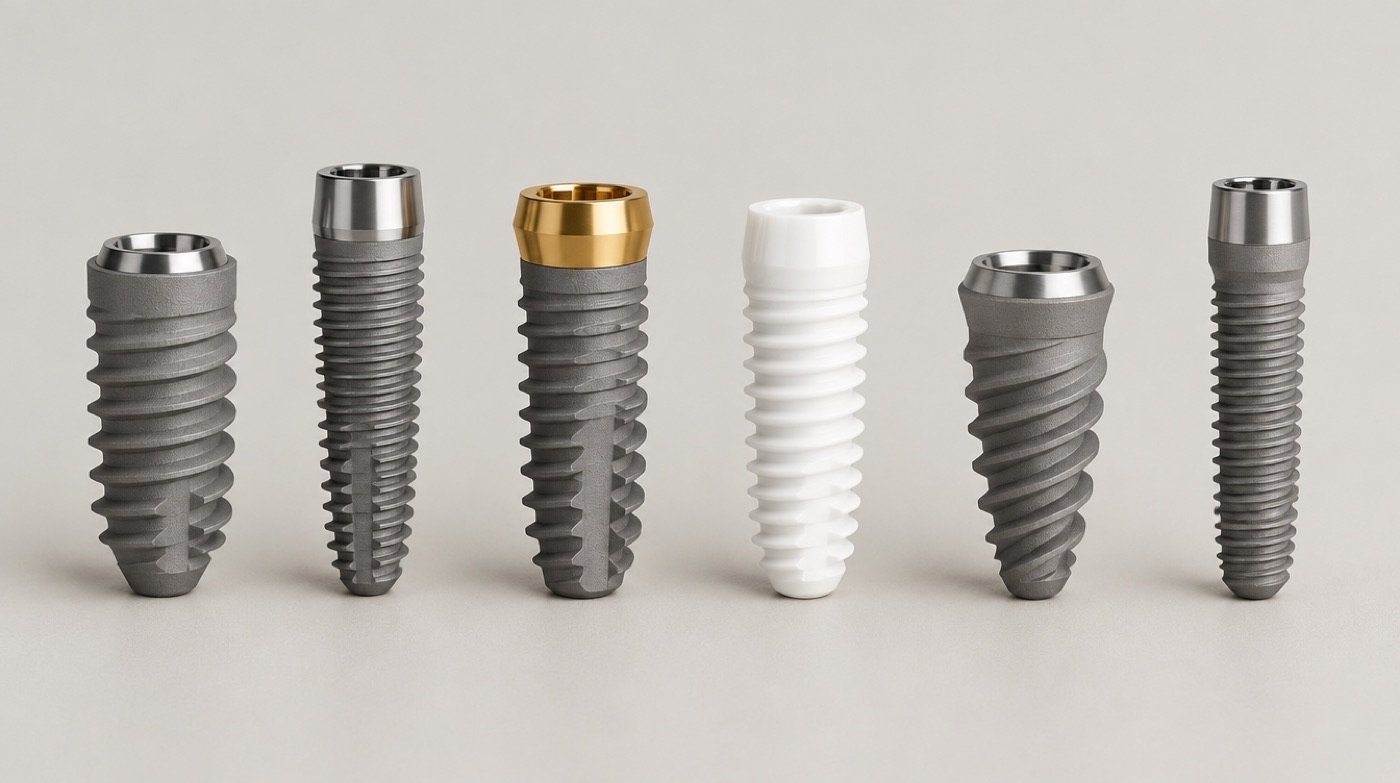
- Four designs: BLX and BLC at bone level, TLX and TLC at tissue level.
- All four share the TorcFit™ connection, so the same range of abutments fits all of them.1
- 'X' designs (BLX, TLX) are aimed at immediate protocols; 'C' designs (BLC, TLC) are Straumann's tapered implants for all indications.1
- Your dentist, not a brochure, decides which of the four suits your situation.
How the four designs fit together
It helps to think of iEXCEL as a 2 × 2 grid. One question is where the implant ends: at the level of the bone (bone level) or rising through the gum (tissue level). The other is the design family: the 'X' line, which Straumann positions for immediacy, and the 'C' line, which it calls its new generation of tapered implants for all indications.1
| X-Line (immediacy) | C-Line (all indications) | |
|---|---|---|
| Bone level | BLX — fully tapered | BLC — apically tapered |
| Tissue level | TLX | TLC |
The FDA summary for BLC and TLC describes BLC as an apically tapered bone-level implant with a thread pitch of 0.8–1.15 mm, compared with BLX, which is fully tapered with a much coarser thread (2.0–2.8 mm pitch for the compared sizes).2 In plain words: the C designs have finer threads and a slimmer tip, the X designs have deeper threads designed to grip.
Why one connection matters to patients
All four designs use the same TorcFit™ connection with the same connection diameter for prosthetics, according to Straumann.1 For a patient this has a practical meaning: the abutments, scan bodies and restorative parts are shared across the system, which can make future repairs and replacements simpler.
Would you like a dentist to assess whether this treatment suits you?
Request an assessmentMaterials and surfaces used
The FDA summaries for BLX, TLX, BLC and TLC all list the implant body material as a titanium–13 zirconium alloy, which Straumann markets as Roxolid®, with the SLA® or hydrophilic SLActive® surface.342
Straumann describes Roxolid® as stronger than titanium and 'biologically superior', enabling smaller implants and less invasive treatment. 15
Independent systematic reviews of narrow titanium–zirconium implants report outcomes similar to titanium narrow implants over short follow-up (up to about 3 years). They do not show that Roxolid gives better survival.
What iEXCEL does not tell you
- It does not tell you which of the four designs is right for you. That depends on your bone, the site, the planned restoration and the surgeon's assessment.
- A newer system is not automatically better for every case. Older Straumann lines such as Bone Level Tapered and Tissue Level remain in use.
- Marketing phrases such as 'performance system' describe the manufacturer's positioning, not independent evidence.
Frequently asked questions
Is iEXCEL an implant?
Which iEXCEL implant is best?
Are BLX and BLC the same implant?
Last updated 28 Sep 2026 · How we review
Sources
- Manufacturer documentationStraumann iEXCEL™ system (product page) — Institut Straumann AG. Accessed 28 Sep 2026.
- Regulatory recordFDA 510(k) K230108 — Straumann BLC and TLC Implants (510(k) summary) — U.S. Food and Drug Administration, 2023-09-14. Accessed 28 Sep 2026.
- Regulatory recordFDA 510(k) K173961 — Straumann BLX Implant System (510(k) summary) — U.S. Food and Drug Administration, 2018-06-05. Accessed 28 Sep 2026.
- Regulatory recordFDA 510(k) K200586 — Straumann TLX Implant System (510(k) summary) — U.S. Food and Drug Administration, 2020-08-20. Accessed 28 Sep 2026.
- Manufacturer documentationStraumann® Roxolid® (material page) — Institut Straumann AG. Accessed 28 Sep 2026.
- Systematic reviewIegami CM et al. Survival of titanium-zirconium vs commercially pure titanium narrow-diameter implants: systematic review and meta-analysis — Clin Implant Dent Relat Res, 2017. Accessed 28 Sep 2026.
- Systematic reviewCao R et al. Clinical outcomes of titanium-zirconium narrow-diameter implants for single crowns: systematic review and meta-analysis — Br J Oral Maxillofac Surg, 2023. Accessed 28 Sep 2026.
Educational information only. The choice of implant system depends on your anatomy, restorative plan, bone quality and the clinician's assessment. This website does not recommend a specific implant for you.