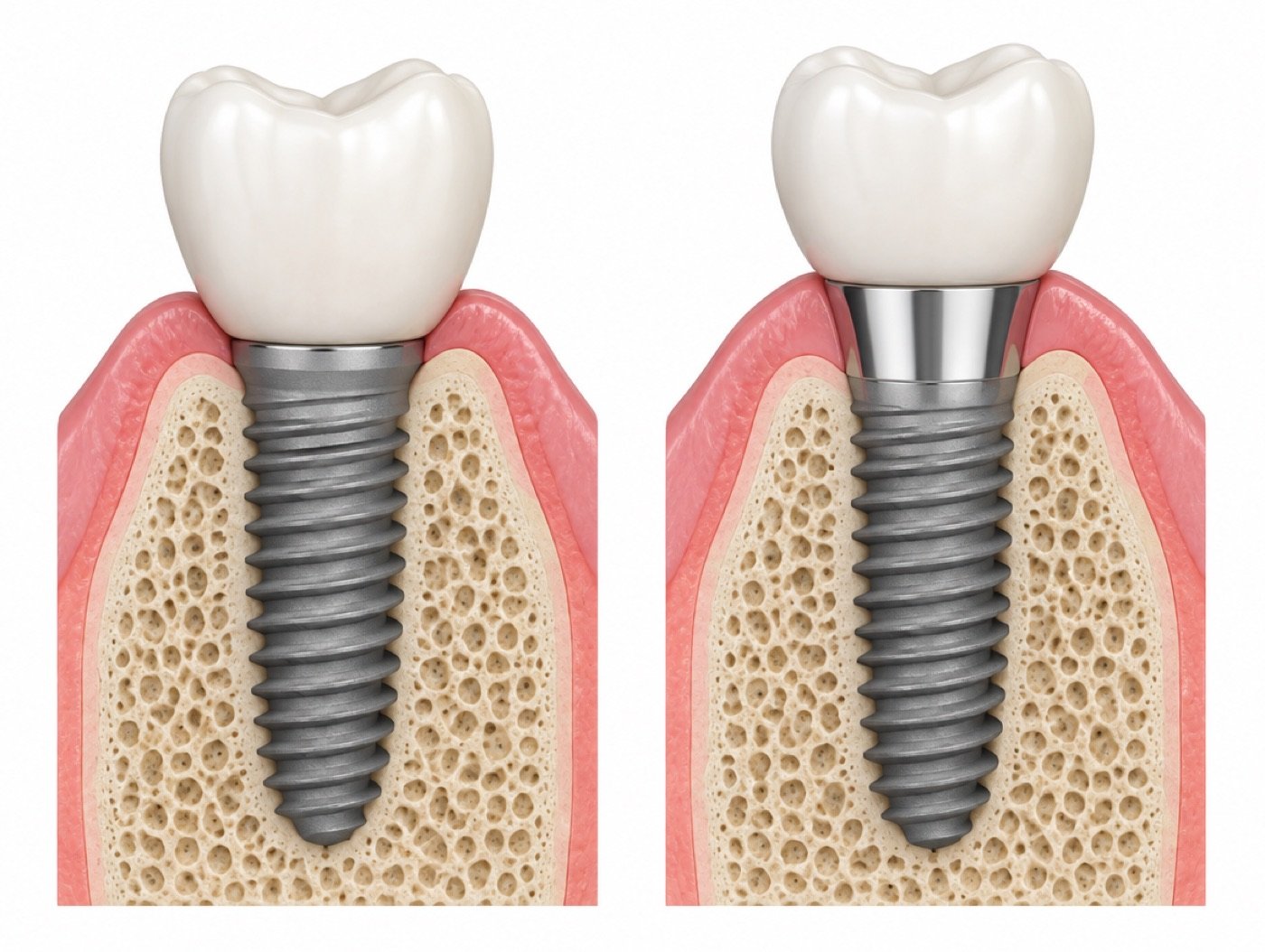
What long-term studies report
A retrospective study of 1,692 Straumann tissue-level implants reported 10-year cumulative survival of 98.23% at implant level and 95.70% at patient level. 4
Survival was related to implant diameter, length, site and insertion torque.
In an independent retrospective study of 511 titanium implants with an SLA surface in 303 patients, 10-year implant survival was 98.8% and success 97.0%. 5
Patients were orally healthy and followed at a university clinic. Results from one centre cannot be transferred to every patient.
The 4 mm short implant
The Straumann 4 mm Short Implants are made from Roxolid® with the SLActive® surface, in Ø4.1 mm (RN) and Ø4.8 mm (RN or WN).3 Straumann positions it for limited bone height where bone reconstruction is not desired.6
A systematic review of randomised trials compared short (≤6 mm) implants with ≥10 mm implants across different clinical scenarios. 7
See the review for scenario-specific results and the quality-of-evidence grading.
Would you like a dentist to assess whether this treatment suits you?
Request an assessmentLast updated 28 Sep 2026 · How we review
Sources
- Regulatory recordFDA 510(k) K223083 — Straumann SLActive labeling changes — U.S. Food and Drug Administration, 2023-06-22. Accessed 28 Sep 2026.
- Regulatory recordFDA 510(k) K111357 — Straumann Narrow Neck CrossFit (NNC) Ø3.3 mm Implant — U.S. Food and Drug Administration, 2011-10-03. Accessed 28 Sep 2026.
- Regulatory recordFDA 510(k) K202942 — Straumann 4 mm Short Implants — U.S. Food and Drug Administration, 2021-02-08. Accessed 28 Sep 2026.
- Independent clinical studyKim S et al. Retrospective study of 1692 Straumann tissue-level implants over 10 years — Clin Implant Dent Relat Res, 2018. Accessed 28 Sep 2026.
- Independent clinical studyBuser D et al. 10-year survival and success rates of 511 titanium implants with a sandblasted and acid-etched surface — Clin Implant Dent Relat Res, 2012. Accessed 28 Sep 2026.
- Manufacturer documentationImplants for anatomical challenges — Institut Straumann AG. Accessed 28 Sep 2026.
- Systematic reviewRavidà A et al. Short (≤6 mm) compared with ≥10 mm implants: systematic review of RCTs — J Clin Periodontol, 2024. Accessed 28 Sep 2026.
Educational information only. The choice of implant system depends on your anatomy, restorative plan, bone quality and the clinician's assessment. This website does not recommend a specific implant for you.