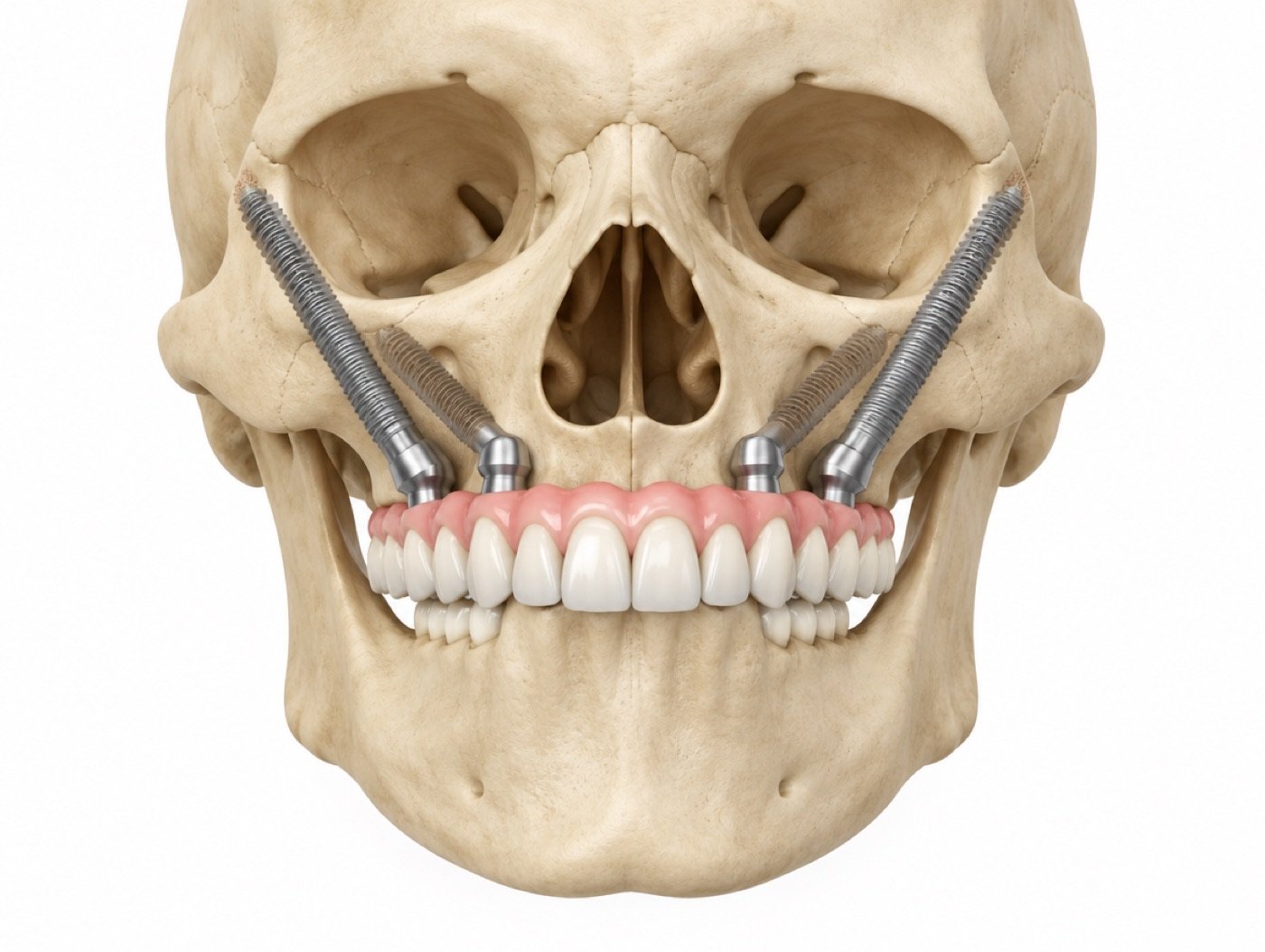
Not an easy alternative to bone grafting
Straumann markets its zygomatic system as 'immediate, graftless, predictable'.1 That is the manufacturer's framing. Zygomatic surgery is complex, is performed close to the sinus and the eye socket, and is usually done by oral and maxillofacial surgeons with specific training.
The ITI consensus report on zygomatic implants found mean long-term zygomatic implant survival of 96.2% over a mean follow-up of 6.3 years, with sinusitis occurring in 14.2% of cases. 2
These pooled figures cover zygomatic implants in general, not one manufacturer's system.
ZAGA Flat and ZAGA Round
ZAGA (Zygoma Anatomy-Guided Approach) classifies the upper jaw into types 0 to IV. Straumann matches ZAGA Round to types 0–I and ZAGA Flat to types II–IV.1 The surgeon chooses the design from your 3D scan.
Would you like a dentist to assess whether this treatment suits you?
Request an assessmentRisks to discuss with the surgeon
- Sinusitis. The ITI consensus reports an overall prevalence of 14.2%.2
- Soft-tissue problems around the implant heads.
- Rare but serious complications near the eye socket.
- Need for specialist follow-up.
Frequently asked questions
Are Straumann zygomatic implants available in the USA?
Last updated 28 Sep 2026 · How we review
Sources
- Manufacturer documentationStraumann® Zygomatic Implant System (product page) — Institut Straumann AG. Accessed 28 Sep 2026.
- Consensus / guidelineAl-Nawas B et al. ITI consensus report on zygomatic implants — Int J Implant Dent, 2023. Accessed 28 Sep 2026.
- Regulatory recordopenFDA: 510(k) clearances with applicant 'Straumann', product code DZE (69 records, 1990–2026) — U.S. Food and Drug Administration. Accessed 28 Sep 2026.
Educational information only. The choice of implant system depends on your anatomy, restorative plan, bone quality and the clinician's assessment. This website does not recommend a specific implant for you.