What BLX is
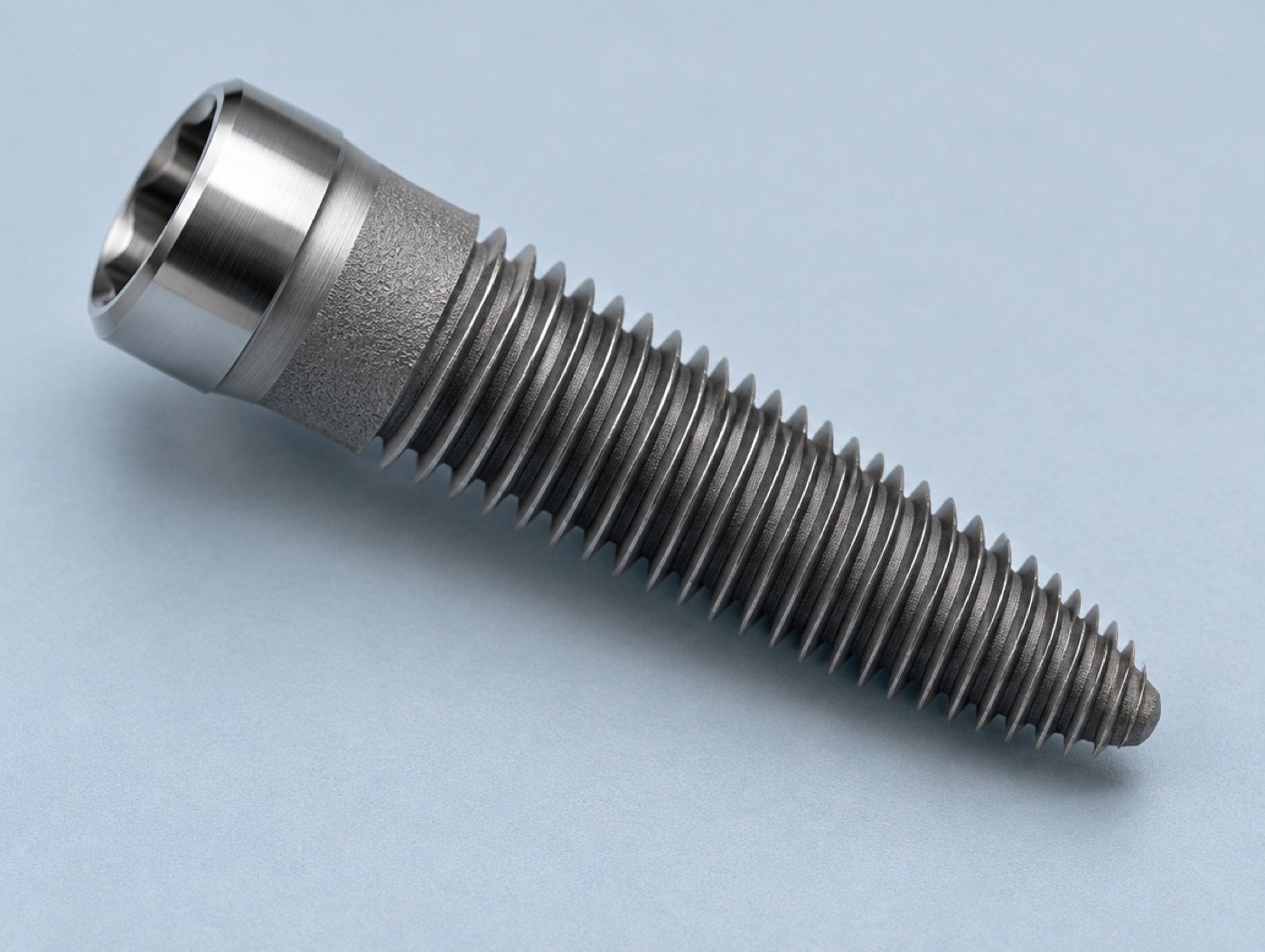
BLX belongs to Straumann's iEXCEL system and is its fully tapered bone-level design.3 Straumann's technical guide describes endosteal diameters from 3.5 to 6.5 mm and lengths from 6 to 18 mm, with two prosthetic platforms: RB (regular base) and WB (wide base).2
The thread pitch changes with implant diameter and length (from about 1.7 mm up to 3.1 mm), and the apex has two or four cutting edges depending on the diameter.2 These details matter to the surgeon because they affect how the implant cuts and grips during placement.
Material and surface
BLX implants are made from Roxolid®, which the FDA filing describes as a titanium–13 zirconium alloy.1 They are available with the SLActive® surface, which FDA documents describe as hydrophilic, or the SLA® surface.12
Straumann describes Roxolid® as an alloy of 85% titanium and 15% zirconium. 4
In its FDA 510(k) summaries, Straumann describes the Roxolid® material as a titanium–13 zirconium (Ti-13Zr) alloy. 516
The regulatory wording (Ti-13Zr) and the marketing wording (15% zirconium) differ slightly. Both describe a titanium-zirconium alloy; we show both rather than choose one.
Would you like a dentist to assess whether this treatment suits you?
Request an assessmentThe TorcFit connection
BLX uses the TorcFit™ connection: a 7° cone with a Torx-style six-position index. All BLX implants share the same inner geometry regardless of diameter, so one set of prosthetic components serves the whole range.2 Wider BLX implants (over Ø5.0 mm) also have a 22.5° shoulder for wider emergence profiles.2
Immediate placement and loading
The US labeling for BLX allows immediate function on single-tooth applications when good primary stability and appropriate occlusal loading are achieved. 1
Labeling describes what is permitted; it does not guarantee same-day teeth for any individual patient.
The ITI consensus on placement and loading protocols treats immediate loading as a clinical decision based on factors such as primary stability, bone and the restoration, not as a property of an implant brand. 7
Straumann's technical guide notes that for immediate function a final insertion torque of at least 35 Ncm should be achieved.2 In practice this means the surgeon measures stability at placement and decides then. It cannot be promised in advance.
When BLX may not be the obvious choice
An implant designed for grip in soft bone is not automatically the best choice everywhere. Clinicians may prefer a different Straumann design in situations such as:
- Very dense bone, where a less aggressive thread may be easier to control, for example BLC or Bone Level Tapered.
- Cases where the clinician wants the implant–abutment join above the bone: the tissue-level TLX or TLC.
- Very narrow gaps between front teeth, where the Ø2.9 mm Bone Level Tapered may be considered.
- Limited bone height, where short implants may be discussed (see short implants).
- Patients who prefer a metal-free implant: PURE Ceramic.
Straumann itself advises particular care when placing Ø3.5 mm Roxolid implants in the molar region or other high-load situations.2
Regulatory record
BLX was first cleared by the FDA in 2018 (K173961), with later clearances for the Ø3.5 mm implant (K191256) and wider/longer sizes (K212533).18 A 510(k) clearance means the FDA found the device substantially equivalent to a legally marketed device. It is not an 'FDA approval' and not a quality ranking.
Frequently asked questions
Is Straumann BLX good for immediate implants?
What is BLX made of?
How much does a BLX implant cost?
Last updated 28 Sep 2026 · How we review
Sources
- Regulatory recordFDA 510(k) K173961 — Straumann BLX Implant System (510(k) summary) — U.S. Food and Drug Administration, 2018-06-05. Accessed 28 Sep 2026.
- Manufacturer documentationStraumann® BLX Implant System — Basic Information (702115) — Institut Straumann AG, 2024-11. Accessed 28 Sep 2026.
- Manufacturer documentationStraumann iEXCEL™ system (product page) — Institut Straumann AG. Accessed 28 Sep 2026.
- Manufacturer documentationStraumann® Roxolid® (material page) — Institut Straumann AG. Accessed 28 Sep 2026.
- Regulatory recordFDA 510(k) K150938 — Straumann Dental Implant System — Roxolid SLA Implants — U.S. Food and Drug Administration, 2015-07-24. Accessed 28 Sep 2026.
- Regulatory recordFDA 510(k) K230108 — Straumann BLC and TLC Implants (510(k) summary) — U.S. Food and Drug Administration, 2023-09-14. Accessed 28 Sep 2026.
- Consensus / guidelineMorton D et al. Group 5 ITI Consensus Report: Implant placement and loading protocols — Clin Oral Implants Res, 2023. Accessed 28 Sep 2026.
- Regulatory recordopenFDA: 510(k) clearances with applicant 'Straumann', product code DZE (69 records, 1990–2026) — U.S. Food and Drug Administration. Accessed 28 Sep 2026.
Educational information only. The choice of implant system depends on your anatomy, restorative plan, bone quality and the clinician's assessment. This website does not recommend a specific implant for you.